
Postcard from Spain. Sent by Eva.
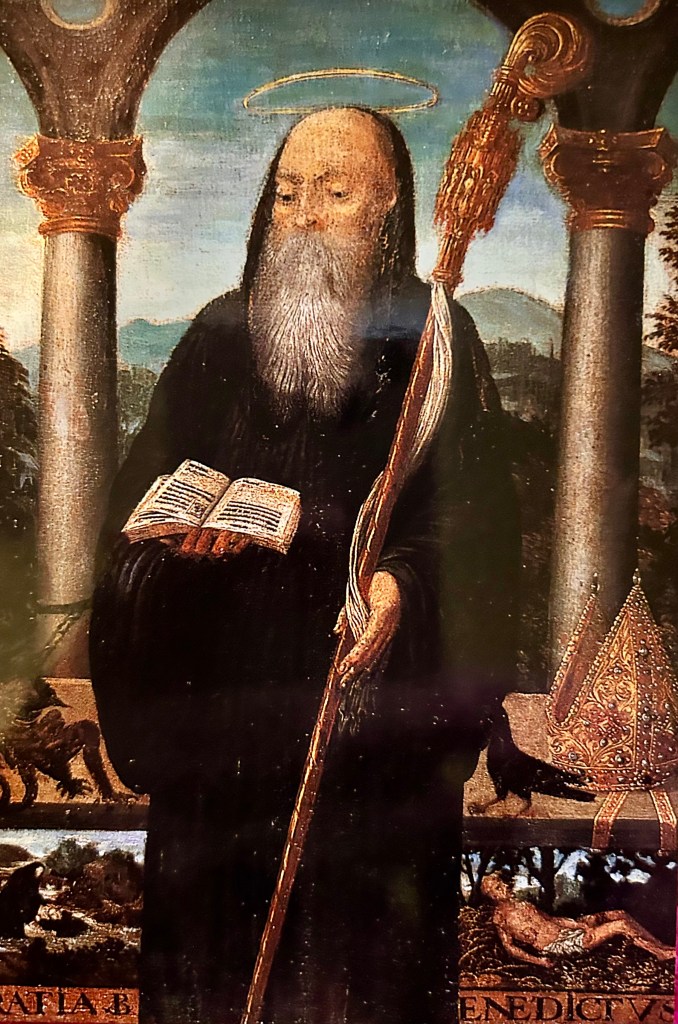
Benedict holds an open book, representing the monastic rules he established. The ornate staff signifies his role as an abbot. A raven is often depicted with Saint Benedict, referencing a story in which a bird carried away poisoned bread intended to kill him. The ceremonial headdress on the ledge is another symbol of his abbatial authority. *
The only ancient account of Benedict is found in the second volume of Pope Gregory I’s four-book Dialogues, thought to have been written in 593, although the authenticity of this work is disputed.
Benedict was the son of a Roman noble of Nursia, the modern Norcia, in Umbria. According to Gregory’s narrative, Benedict was born around 480, and the year in which he abandoned his studies and left home “was probably a few years before 500.”
Benedict was sent to Rome to study, but was disappointed by the academic studies he encountered there. Seeking to flee the great city, he left with his nurse and settled in Enfide. Enfide, which the tradition of Subiaco identifies with the modern Affile, is in the Simbruini mountains, about forty miles from Rome and two miles from Subiaco.
A short distance from Enfide is the entrance to a narrow, gloomy valley, penetrating the mountains and leading directly to Subiaco. The path continues to ascend, and the side of the ravine on which it runs becomes steeper until a cave is reached. Above this point the mountain now rises almost perpendicularly, while on the right, it strikes in a rapid descent down to where, in Benedict’s day, 500 feet (150 m) below, lay the blue waters of a lake. The cave has a large triangular-shaped opening and is about ten feet deep. On his way from Enfide, Benedict met a monk, Romanus of Subiaco, whose monastery was on the mountain above the cliff overhanging the cave. Romanus discussed with Benedict the purpose that had brought him to Subiaco, and gave him the monk’s habit. By his advice, Benedict became a hermit and for three years lived in this cave above the lake.
Gregory tells little of Benedict’s later life. He now speaks of Benedict no longer as a youth (puer), but as a man (vir) of God. Romanus, Gregory states, served Benedict in every way he could. The monk apparently visited him frequently and on fixed days brought him food.
During these three years of solitude, broken only by occasional communications with the outer world and by the visits of Romanus, Benedict matured both in mind and character, in knowledge of himself and of his fellow-man, and at the same time he became not merely known to, but secured the respect of, those about him; so much so that on the death of the abbot of a monastery in the neighbourhood (identified by some with Vicovaro), the community came to him and begged him to become its abbot. Benedict was acquainted with the life and discipline of the monastery, and knew that “their manners were diverse from his and therefore that they would never agree together: yet, at length, overcome with their entreaty, he gave his consent”. The experiment failed; the monks tried to poison him. They first tried to poison his drink. Benedict made the sign of the cross over the cup, and the cup shattered as if he had not made the sign of the cross, but had thrown a stone at the vessel. Thus Benedict advised the monks to seek an abbot of their own kind, left the group, and went back to his cave at Subiaco.
There lived in the neighborhood a priest called Florentius who, moved by envy, attempted to kill Benedict with a loaf of poisoned bread. When he prayed a blessing over the bread, a raven swept in and took the loaf away. From this time, his miracles seem to have become frequent, and many people, attracted by his sanctity and character, came to Subiaco to be under his guidance. Having failed by sending him poisonous bread, Florentius tried to seduce his monks with some prostitutes. To avoid further temptations, in about 530 Benedict left Subiaco. He founded 12 monasteries in the vicinity of Subiaco, and, eventually, in 530, he founded the great Benedictine monastery of Monte Cassino, which lies on a hilltop between Rome and Naples.
Benedict died of a fever at Monte Cassino not long after his sister, Scholastica, and was buried in the same tomb. According to tradition, this occurred on 21 March 547.
His feast is on 11 July.
[source: Wikipedia]


Glad to know you got it! I hope your collection grows little by little 🙂
LikeLike
Yes. Thank you so much! I love it! I just came back from Italy (yay!). I will respond to explain more about the collection through snail mail 🙂 [so happy you had one: they are so rare]
LikeLike