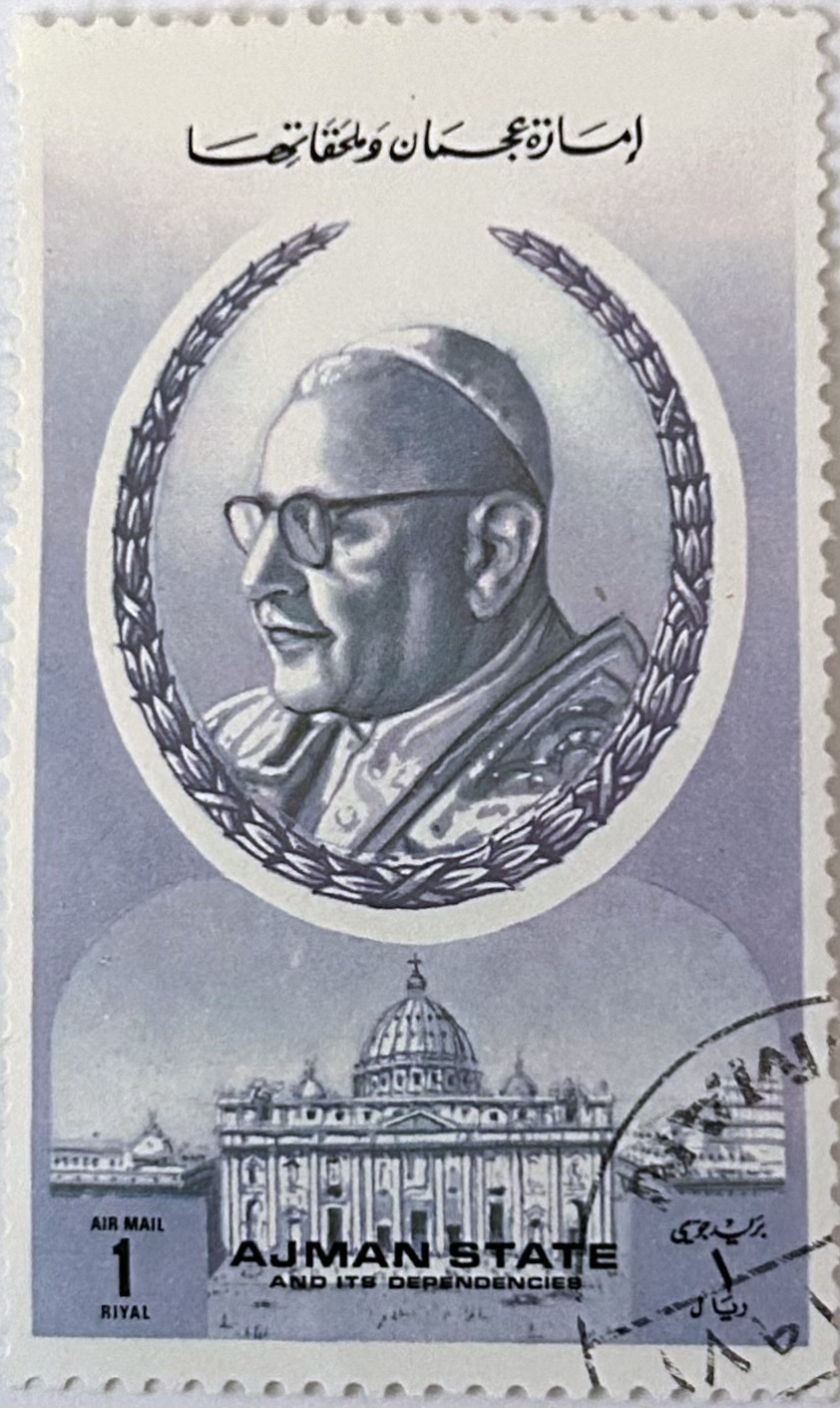
Pope John XXIII was head of the Catholic Church and sovereign of Vatican City from 28 October 1958 until his death on 3 June 1963.
A leading cardinal present when the coffin of Pope John XXIII was opened after 38 years today said the pontiff looked as if he had “died yesterday.” “None of the body had decomposed,” said Cardinal VirgilioNoe, the high priest of St. Peter’s Basilica, who oversaw the opening of the coffin to prepare the removal of the tomb to a new space more accessible to pilgrims.
Angelo Giuseppe Roncalli, the third of thirteen children, was born on November 25, 1881 at Sotto il Monte (Bergamo) of a family of sharecroppers. He attended elementary school in the town, was tutored by a priest of Carvico, and at the age of twelve entered the seminary at Bergamo. A scholarship from the Cerasoli Foundation (1901) enabled him to go on to the Apollinaris in Rome where he studied under (among others) Umberto Benigni, the Church historian. He interrupted his studies for service in the Italian Army but returned to the seminary, completed his work for a doctorate in theology, and was ordained in 1904. Continuing his studies in canon law he was appointed secretary to the new bishop of Bergamo, Giacomo Radini-Tedeschi. Angelo served this social-minded prelate for nine years, acquiring first-hand experience and a broad understanding of the problems of the working class. He also taught apologetics, church history, and patrology.
With the entry of Italy into World War I in 1915 he was recalled to military service as a chaplain. On leaving the service in 1918 he was appointed spiritual director of the seminary, but found time to open a hostel for students in Bergamo. It was at this time also that he began the research for a multi-volume work on the episcopal visitation of Bergamo by St. Charles Borromeo, the last volume of which was published after his elevation as pope.
In 1921 he was called to Rome to reorganize the Society for the Propagation of the Faith. Nominated titular archbishop of Areopolis and apostolic visitator to Bulgaria (1925), he immediately concerned himself with the problems of the Eastern Churches. Transferred in 1934 to Turkey and Greece as apostolic delegate, he set up an office in Istanbul for locating prisoners of war. In 1944 he was appointed nuncio to Paris to assist in the Church’s post-war efforts in France, and became the first permanent observer of the Holy See at UNESCO, addressing its sixth and seventh general assemblies in 1951 and 1952. In 1953 he became cardinal-patriarch of Venice, and expected to spend his last years there in pastoral work. He was correcting proofs of the synodal Acts of his first diocesan Synod (1958) when he was called to Rome to participate in the conclave that elected him pope.
In his first public address Pope John expressed his concern for reunion with separated Christians and for world peace. In his coronation address he asserted “vigorously and sincerely” that it was his intention to be a pastoral pope since “all other human gifts and accomplishments—learning, practical experience, diplomatic finesse—can broaden and enrich pastoral work but they cannot replace it.” One of his first acts was to annul the regulation of Sixtus IV limiting the membership of the College of Cardinals to 70; within the next four years he enlarged it to 87 with the largest international representation in history. Less than three months after his election he announced that he would hold a diocesan synod for Rome, convoke an ecumenical council for the universal Church, and revise the Code of Canon Law. The synod, the first in the history of Rome, was held in 1960; Vatican Council II was convoked in 1962; and the Pontifical Commission for the Revision of the Code was appointed in 1963.
His progressive encyclical, Mater et Magistra, was issued in 1961 to commemorate the anniversary of Leo XIII’s Rerum novarum. Pacem in terris, advocating human freedom and dignity as the basis for world order and peace, came out in 1963. He elevated the Pontifical Commission for Cinema, Radio, and Television to curial status, approved a new code of rubrics for the Breviary and Missal, made notable advances in ecumenical relations by creating a new Secretariat for Promoting Christian Unity and by appointing the first representative to the Assembly of the World Council of Churches held in New Delhi (1961). In 1960 he consecrated fourteen bishops for Asia, Africa, and Oceania. The International Balzan Foundation awarded him its Peace Prize in 1962.
Since his death on June 3, 1963, much has been written and spoken about the warmth and holiness of the beloved Pope John. Perhaps the testimony of the world was best expressed by a newspaper drawing of the earth shrouded in mourning with the simple caption, “A Death in the Family.”