
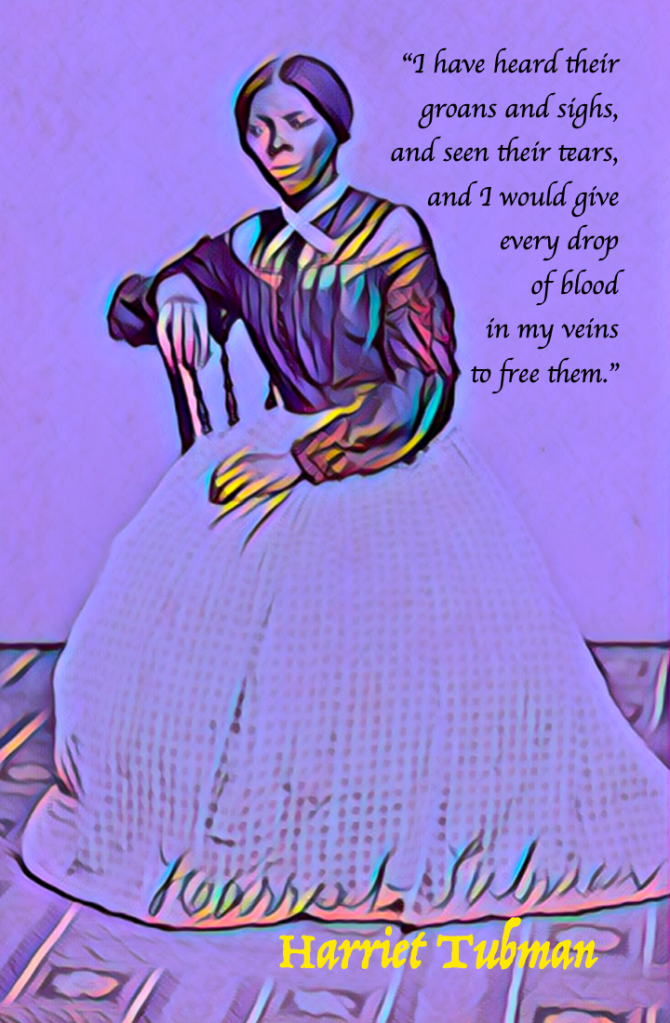
American anti-slavery and women’s rights campaigner Harriet Tubman (1820–1913) escaped slavery to become one of the leading abolitionists in the time before the American Civil War (1861–65). She was put to work as a house servant at around the age of five or six years old, and experienced physical violence, including whippings, from that time. Having escaped and fled to Philadelphia, she led hundreds of slaves to freedom along the Underground Railroad and served as a scout, a nurse, and a spy in the Union forces during the Civil War. In later life, she spoke out for women’s suffrage, giving speeches in favor of women’s right to vote. Her bravery and generosity of spirit have continued to inspire generations of Americans.
Born Araminta Ross around 1822, she escaped slavery in 1849 and adopted the name Harriet Tubman.
- Tubman became the most famous “conductor” on the Underground Railroad, making at least thirteen trips into slaveholding territory between 1850 and 1860, guiding as many as seventy enslaved people to freedom.
- During the Civil War, she worked for the Union Army as a cook, nurse, and armed scout, even leading a military expedition, the Combahee River Raid, which liberated over 700 enslaved people.
- A head injury in her youth left her with lifelong complications, including seizures and vivid dreams she interpreted as divine guidance.
- Despite not being able to read or write, she was a brilliant strategist and a leader on the Underground Railroad, earning the nickname “Moses”.
- In her later years, Tubman underwent brain surgery to address the effects of her earlier head injury. She famously refused anesthesia, biting down on a bullet during the procedure, a practice she’d observed among soldiers.
- In June 1863, Tubman was the first woman to lead an armed assault during the Civil War, guiding Union troops in the Combahee River Raid.
- Tubman actively participated in the women’s suffrage movement, working alongside prominent figures like Susan B. Anthony.
- Interestingly, Tubman’s favorite color was orange, which she associated with giving and strength.
- Tubman died in the Home for the Aged she herself had founded.
- Harriet Tubman died on March 10, 1913, at the rest home named in her honor in Auburn, New York. She was buried with military honors in the Fort Hill Cemetery in Auburn, which also included such figures as Secretary of State William Seward.
- This specific photograph of Tubman at age 42 was reportedly taken in 1864 and was jointly acquired by the National Museum of African American History and Culture and the Library of Congress in 2017.
Linked to April Blogging from A to Z Challenge

 Postcards Etc